Water damage restoration for the Elsinore Valley
Lake Elsinore Water Damage Restoration covers the water losses that come with living beside the lake and below the canyons: slab leaks, burst pipes, storm runoff and lake-level flooding.
How the restoration team works
Every job starts with a moisture map, not a guess. The tech who does the walkthrough reads the floors, walls and slab before any equipment goes down, so the drying plan follows the water instead of the stain.
The extraction crew pulls standing water first with truck-mounted pumps. The drying team then sets air movers and LGR dehumidifiers to the evaporation load of each room and takes readings every day. Equipment stays until the wet materials read within a few points of a dry reference in the same house, the drying goal in the IICRC S500 standard.
Sewage, lake overflow and canyon runoff are Category 3. The mitigation team handles them with containment, protective gear, removal of porous materials and an EPA-registered antimicrobial.
Find us on Google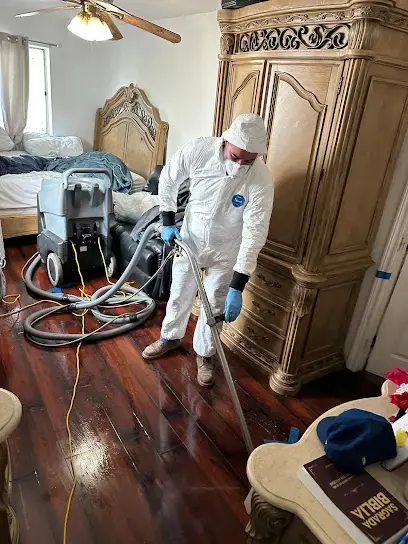
What the work is held to
IICRC S500 drying standard
Losses are classified by category and class, dried with the right equipment and verified with readings.
Structural drying, not surface drying
Framing, subfloor, wall cavities and the slab are dried, not just the carpet you can see.
Claim-ready documentation
Moisture maps, daily logs and photos taken before any demolition, the records adjusters look for.
Elsinore Valley water knowledge
Slab-on-grade tracts, lakeshore streets, canyon neighborhoods and manufactured-home communities each fail differently.
Water damage in the Elsinore Valley?
Extraction, structural drying and sewage cleanup for Lake Elsinore, Lakeland Village, Wildomar and Canyon Lake.